Predictive Soil Spectroscopy

Welcome!
Welcome to this training guide on Predictive Soil Spectroscopy! This material was originally developed for an in-person workshop in 2023 and has since been used in multiple training events and reused by many practitioners worldwide. It is now maintained as a living document, open for anyone to access and build upon.
Training workshops:
- Predictive Soil Spectroscopy (Pre-conforence workshop) at the ASA-CSSA-SSSA International Annual Meeting 2023 (St. Louis, MO, USA).
- Introduction to Soil Spectroscopy Modeling at FUNCEME, Fortaleza, CE, Brazil, 2024.
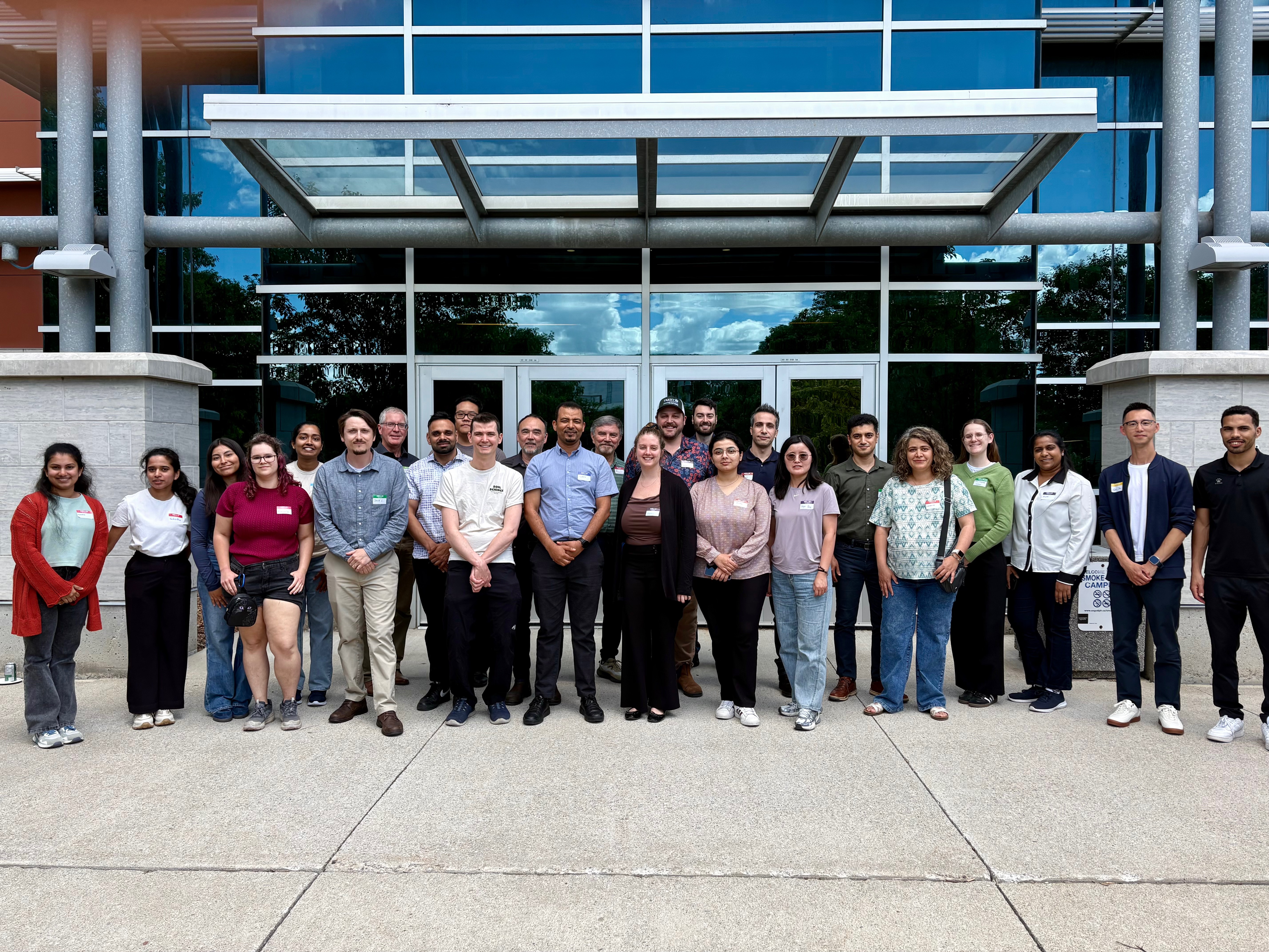
- Predictive Soil Spectroscopy (a session of the full-day pre-conference workshop “Soil Spectroscopy: The nuts and bolts of soil spectroscopy science and applications”) at the 2026 CSSS-CSA Meeting (University of Guelph, ON, Canada).
Soil spectroscopy, specifically Diffuse Reflectance Spectroscopy, is rapidly becoming a routine tool for soil analysis in academia and in industry.
One of the most popular uses of soil spectroscopy is for the rapid and low-cost estimation of particle size distribution, carbon fractions, and clay minerals.
This guide touches on the basics of soil spectroscopy development including project design, considerations for building a spectral library, working with large and public spectral libraries, and predictive modeling.
Most of the learning will focus on using the free and open source R programming language.
This material was updated with R version 4.5.3, and it is recommended to use RStudio as the graphical user interface. Package versions are managed with renv for reproducibility. To restore the exact package environment used in this guide, run renv::restore() after cloning or downloading the repository.
Prerequisites
This training is mostly focused on the use of tidy programming principles with pipe operators, leveraging the R packages from the tidyverse like dplyr, tidyr, and ggplot2.
For the machine learning framework, this guide uses the tidymodels ecosystem, which provides a consistent and user-friendly interface for model building and evaluation.
Alternatively, we have included a chemometrics chapter where some common tools and algorithms for working with spectral data are introduced. This was possible with the availability of the amazing package mdatools.
We do, however, recommend that you keep an eye on this online material as it may evolve in time and new methods may be incorporated.
If you are interested in getting started in R using tidy packages and principles, we strongly recommend checking the R 4 Data Science book page:
- For installing R and RStudio, it is recommended to check the Prerequisites page.
- Learning how to set a basic project on RStudio is neatly described in Workflow: projects.
- We are going to have several demonstrations of data import and wrangling by piped operations, and plot visualizations with ggplot.
Other spectral operations, like importing raw spectral files, preprocessing, compression, and modeling can be done with dedicated libraries, e.g., asdreader, opusreader2, prospectr, resemble, tidymodels, and many others.
Recommended literature
Fundamentals of infrared spectroscopy are well presented in Johnston & Aochi (2018), Stenberg & Viscarra-Rossel (2010), Margenot et al. (2017), Pasquini (2003), while Wadoux et al. (2021) dedicated an exclusive book with examples for soil spectral inference in R.
Some recommended reading:
Johnston, C. T., & Aochi, Y. O. (2018). Fourier Transform Infrared and Raman Spectroscopy (pp. 269–321). https://doi.org/10.2136/sssabookser5.3.c10
Stenberg, B., Viscarra-Rossel, R. (2010). Diffuse Reflectance Spectroscopy for High-Resolution Soil Sensing. In: Viscarra Rossel, R., McBratney, A., Minasny, B. (eds) Proximal Soil Sensing. Progress in Soil Science. Springer, Dordrecht. https://doi.org/10.1007/978-90-481-8859-8_3
Margenot A.J., Calderón F.J., Goyne K.W., Mukome F.N.D and Parikh S.J. (2017) IR Spectroscopy, Soil Analysis Applications. In: Lindon, J.C., Tranter, G.E., and Koppenaal, D.W. (eds.) The Encyclopedia of Spectroscopy and Spectrometry, 3rd edition vol. 2, pp. 448-454. Oxford: Academic Press. http://dx.doi.org/10.1016/B978-0-12-409547-2.12170-5
Pasquini, C. (2003). Near Infrared Spectroscopy: fundamentals, practical aspects and analytical applications. Journal of the Brazilian Chemical Society, 14(2), 198–219. https://doi.org/10.1590/s0103-50532003000200006
Wadoux, A. M. J.-C., Malone, B., Minasny, B., Fajardo, M., & McBratney, A. B. (2021). Soil Spectral Inference with R. In Progress in Soil Science. Springer International Publishing. https://doi.org/10.1007/978-3-030-64896-1
Ng, W., Minasny, B., Jeon, S. H., & McBratney, A. (2022). Mid-infrared spectroscopy for accurate measurement of an extensive set of soil properties for assessing soil functions. Soil Security, 6, 100043. https://doi.org/10.1016/j.soisec.2022.100043
Shepherd, K. D., Ferguson, R., Hoover, D., van Egmond, F., Sanderman, J., & Ge, Y. (2022). A global soil spectral calibration library and estimation service. Soil Security, 7, 100061. https://doi.org/10.1016/j.soisec.2022.100061
Safanelli, J. L., Hengl, T., Parente, L. L., Minarik, R., Bloom, D. E., Todd-Brown, K., Gholizadeh, A., Mendes, W. de S., & Sanderman, J. (2025). Open Soil Spectral Library (OSSL): Building reproducible soil calibration models through open development and community engagement. PLOS ONE, 20(1), e0296545. https://doi.org/10.1371/journal.pone.0296545
Soil Spectroscopy for Global Good team. Open Soil Spectral Library. Available in https://docs.soilspectroscopy.org/. https://doi.org/10.5281/zenodo.5759693
Disclaimer
Woodwell Climate Research Center, OpenGeoHub Foundation and its suppliers and licensors hereby disclaim all warranties of any kind, express or implied, including, without limitation, the warranties of merchantability, fitness for a particular purpose and non-infringement. Neither Woodwell Climate Research Center, OpenGeoHub Foundation nor its suppliers and licensors, makes any warranty that the Website will be error free or that access thereto will be continuous or uninterrupted. You understand that you download from, or otherwise obtain content or services through, the Website at your own discretion and risk.
If you notice an error or outdated information, please submit a correction/pull request or open an issue.
License
This website/book and attached software is free to use, and is licensed under the MIT License. The OSSL training data and models, if not otherwise indicated, are available either under the Creative Commons Attribution 4.0 International CC-BY and/or CC-BY-SA license / Open Data Commons Open Database License (ODbL) v1.0.
Acknowledgments
Soil Spectroscopy for Global Good (SS4GG) is an initiative organized by Woodwell Climate Research Center and OpenGeoHub Foundation. The development of this training material was originally supported by the USDA National Institute of Food and Agriculture award #2020-67021-32467 and is currently maintained with institutional support. We are grateful to all participants of the workshops held since 2023 for their feedback and contributions.
Citing
José Lucas Safanelli, Robert Minarik, Jonathan Sanderman, and Tomislav Hengl. Predictive Soil Spectroscopy. 2025. https://doi.org/10.5281/zenodo.16890797
